The Role of Technology in Preventing and Mitigating Marine Pollution
Keywords:
Marine Pollution, Pollution Prevention, Pollution Mitigation, Monitoring Technology, Oil SpillAbstract
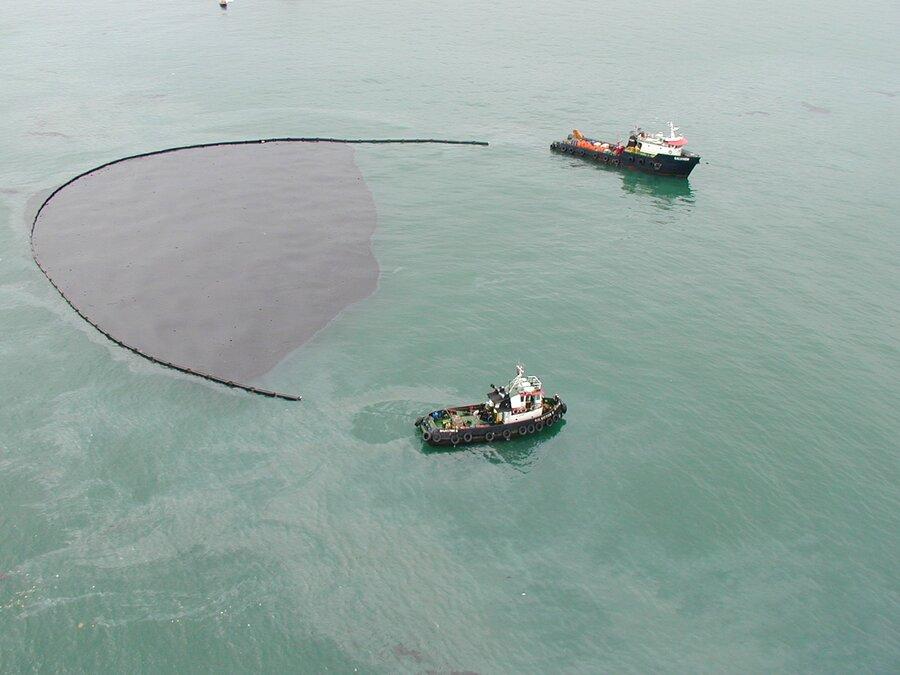
Marine pollution is one of the major environmental challenges that can threaten marine ecosystems, coastal areas, and human activities. Pollution can originate from various sources, including oil spills, ship operations, industrial activities, domestic waste, plastic waste, and offshore activities. The increasing intensity of human activities in marine environments requires the development and application of effective technologies to prevent pollution and minimize its environmental impacts. This study aims to examine the role of technology in preventing and mitigating marine pollution, with a focus on monitoring, detection, containment, treatment, and response technologies. The method used in this study is a literature review based on scientific journals, research articles, books, technical reports, and other relevant sources related to marine pollution prevention and mitigation. The results show that technologies such as remote sensing, oil spill detection systems, containment booms, skimmers, wastewater treatment systems, and digital monitoring can support faster detection, response, and control of marine pollution. The application of these technologies can improve the effectiveness of pollution management and reduce potential impacts on marine ecosystems. However, technological implementation requires appropriate planning, regular maintenance, trained personnel, and integration with environmental management strategies. Therefore, the development and proper application of marine pollution prevention and mitigation technologies are important for supporting effective, sustainable, and environmentally responsible marine management.
References
[1] P. Landrigan et al., “Human Health and Ocean Pollution,” Ann. Glob. Heal., vol. 86, 2020, doi: 10.5334/aogh.2831.
[2] Y. Potiracha and R. Baars, “A review of remote sensing technology for plastic waste monitoring,” Environ. Sci. Pollut. Res. Int., vol. 33, pp. 766–782, 2026, doi: 10.1007/s11356-025-37347-7.
[3] N. N. C. Samsuria, W. Z. W. Ismail, M. N. W. M. Nazli, N. A. B. A. Aziz, and A. Ghazali, “Problems, Effects, and Methods of Monitoring and Sensing Oil Pollution in Water: A Review,” Water, 2025, doi: 10.3390/w17091252.
[4] D. Anthony et al., “Trends in marine pollution mitigation technologies: Scientometric analysis of published literature (1990-2022),” Reg. Stud. Mar. Sci., 2023, doi: 10.1016/j.rsma.2023.103156.
[5] Jingwu, Renfeng, Q. Pan, X. Liang, J. Wang, and X. Ni, “A Global Review of Progress in Remote Sensing and Monitoring of Marine Pollution,” Water, 2023, doi: 10.3390/w15193491.
[6] M. Xie, Y. Li, Z. Zhang, Q. Fu, and H. Jiang, “Remote sensing of the oil spills caused by ships: A review.,” Mar. Pollut. Bull., vol. 214, p. 117754, 2025, doi: 10.1016/j.marpolbul.2025.117754.
[7] D. N. L. Huynh et al., “Booms and skimmers for oil spill recovery: Perspective analysis from lab scale to practical applications.,” Mar. Pollut. Bull., vol. 224, p. 119128, 2025, doi: 10.1016/j.marpolbul.2025.119128.
[8] E. Martínez, “Technological Innovations in Marine Pollution Control Systems,” Am. J. Mar. Eng. Technol., 2025, doi: 10.71465/ajmet1463.
[9] V. Aliko, C. Multisanti, B. Turani, and C. Faggio, “Get Rid of Marine Pollution: Bioremediation an Innovative, Attractive, and Successful Cleaning Strategy,” Sustainability, 2022, doi: 10.3390/su141811784.
[10] A. Newton, J. Icely, I. Kacimi, S. Abalansa, and M. Snoussi, “Contribution of Remote Sensing Technologies to a Holistic Coastal and Marine Environmental Management Framework: A Review,” Remote. Sens., vol. 12, p. 2313, 2020, doi: 10.3390/rs12142313.
[11] H. Babaei, S. Baker, A. Cornett, and A. Pilechi, “Two-Dimensional Computational and Physical Modeling of High-Speed Oil Spill Containment Booms,” J. Waterw. Port Coast. Ocean Eng., vol. 147, p. 4021032, 2021, doi: 10.1061/(asce)ww.1943-5460.0000670.
[12] S. B. Kurniawan et al., “Tackling marine pollution in the blue economy: Synergies between wastewater treatment technologies and governmental policies.,” Mar. Pollut. Bull., vol. 222 Pt 1, p. 118627, 2025, doi: 10.1016/j.marpolbul.2025.118627.
[13] D. Pandey and D. Biswas, “Technological advances in monitoring ocean currents and marine pollutant transport,” Int. J. Aquat. Res. Environ. Stud., 2025, doi: 10.70102/ijares/v5i2/5-2-53.
[14] M. Kim, J. Park, and C.-U. Hyun, “A Review of Oil Spill Detection and Monitoring Techniques Using Satellite Remote Sensing Data and the Google Earth Engine Platform,” J. Mar. Sci. Eng., 2026, doi: 10.3390/jmse14060565.
[15] J. Jamaluddin, M. Musriady, S. Suyuti, and M. Jafar, “Operational Performance Of Oily Water Separator Kl Sultan Hasanuddin 02 Pip Makassar In Protecting The Maritime Environment,” Zo. Laut J. Inov. Sains Dan Teknol. Kelaut., 2024, doi: 10.62012/zl.v5i3.42261.
[16] L. Li, S. Huang, and F. Yan, “Progress in Ship Pollution Prevention and Control Technologies: Regulatory Drivers, Technical Pathways and Intelligent Governance,” Front. Sci. Eng., 2026, doi: 10.54691/pn1z7x42.