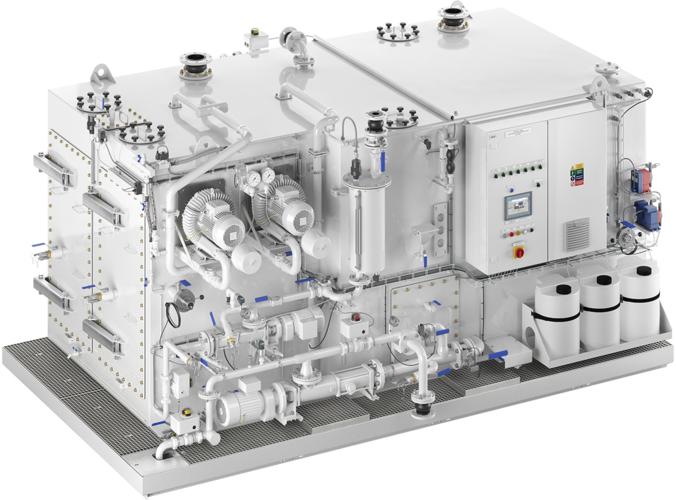
Contaminant Reduction from Ship Wastewater Using Treatment Technology
Keywords:
Ship Wastewater, Contaminant Reduction, Wastewater Treatment, Marine Pollution, Treatment TechnologyAbstract
Ship wastewater is one of the potential sources of marine pollution because it may contain organic matter, nutrients, suspended solids, oil, chemicals, and microorganisms. If wastewater is discharged into the marine environment without adequate treatment, it can negatively affect water quality and marine ecosystems. Therefore, appropriate wastewater treatment technology is needed to reduce contaminants before wastewater is released from ships. This article discusses the application of treatment technology for reducing contaminants in ship wastewater. A literature review method was used by examining scientific publications related to ship wastewater characteristics, wastewater treatment processes, and contaminant reduction technologies. The treatment processes may include physical, biological, and chemical methods, depending on the type and concentration of contaminants present in the wastewater. The reviewed studies indicate that proper treatment can reduce pollutants and improve the quality of treated wastewater before discharge. The effectiveness of the treatment system depends on factors such as wastewater characteristics, treatment technology, operating conditions, maintenance, and system capacity. The application of appropriate wastewater treatment technology can therefore support pollution prevention, improve environmental protection, and contribute to more sustainable maritime operations.
References
[1] Y. Zhang et al., “The Environmental Hazards and Treatment of Ship’s Domestic Sewage,” Toxics, vol. 12, no. 11, 2024, doi: 10.3390/toxics12110826.
[2] J. T. Mujingni, E. Ytreberg, I.-M. Hassellöv, G. B. M. Rathnamali, M. Hassellöv, and K. Salo, “Sampling strategy, quantification, characterization and hazard potential assessment of greywater from ships in the Baltic Sea,” Mar. Pollut. Bull., vol. 208, p. 116993, 2024, doi: https://doi.org/10.1016/j.marpolbul.2024.116993.
[3] O. Pinar and S. Rodríguez-Couto, “Advancements in bilge wastewater treatment: A review for current and future trends,” Sci. Total Environ., vol. 951, p. 175587, 2024, doi: https://doi.org/10.1016/j.scitotenv.2024.175587.
[4] D. Han, H. Chen, Y. Wen, C. Xiao, X. Cheng, and X. Huang, “A multi-level monitoring mechanism for inland ships sewage based on software-defined cloud-edge-end collaborative architecture,” Ocean Coast. Manag., vol. 262, p. 107574, 2025, doi: https://doi.org/10.1016/j.ocecoaman.2025.107574.
[5] J. Leonard, M. Ahmedullah, M. Brown, I. Brundin, and H. Fallowfield, “Bilgewater management in marine vessels : a systematic literature review of marine vessel bilgewater and treatment options,” Environ. Sci. Pollut. Res., vol. 33, no. 14, pp. 6403–6418, 2026, doi: 10.1007/s11356-026-37673-4.
[6] E. García-Gómez et al., “Identification of emerging contaminants in greywater emitted from ships by a comprehensive LC-HRMS target and suspect screening approach,” Environ. Pollut., vol. 366, p. 125524, 2025, doi: https://doi.org/10.1016/j.envpol.2024.125524.
[7] V. Van Der Schyff, M. Stiborek, A. L. King, and L. Melymuk, “Occurrence of Pharmaceuticals and Other Anthropogenic Compounds in the Wastewater Effluent of Arctic Expedition Cruise Ships,” 2025, doi: 10.1021/acs.estlett.5c00209.
[8] Q. Chen, W. Wu, Y. Guo, J. Li, and F. Wei, “Environmental impact, treatment technology and monitoring system of ship domestic sewage: A review,” Sci. Total Environ., vol. 811, p. 151410, 2022, doi: https://doi.org/10.1016/j.scitotenv.2021.151410.
[9] Y. Hao, H. Zhang, H. Zou, J. Wang, L. Sun, and M. Cui, “Pathogen risk control in shipboard domestic wastewater: Current technologies, challenges, and the potential of micro-nanobubbles,” J. Water Process Eng., vol. 90, p. 110376, 2026, doi: https://doi.org/10.1016/j.jwpe.2026.110376.
[10] C. Vaneeckhaute and A. Fazli, “Management of ship-generated food waste and sewage on the Baltic Sea: A review,” Waste Manag., vol. 102, pp. 12–20, 2020, doi: https://doi.org/10.1016/j.wasman.2019.10.030.
[11] Y. L. Jang, J. Jeong, S. Eo, S. H. Hong, and W. J. Shim, “Occurrence and characteristics of microplastics in greywater from a research vessel,” Environ. Pollut., vol. 341, p. 122941, 2024, doi: https://doi.org/10.1016/j.envpol.2023.122941.
[12] S. Kato and Y. Kansha, Comprehensive review of industrial wastewater treatment techniques, vol. 31, no. 39. Springer Berlin Heidelberg, 2024. doi: 10.1007/s11356-024-34584-0.
[13] M. Asheghmoalla and M. Mehrvar, “Integrated and Hybrid Processes for the Treatment of Actual Wastewaters Containing Micropollutants: A Review on Recent Advances,” Processes, vol. 12, no. 2, 2024, doi: 10.3390/pr12020339.
[14] Y. Cai et al., “Wastewater treatment for ships experiencing large temperature changes: the activated sludge/membrane-biofilm reactor,” Chemosphere, vol. 307, p. 135852, 2022, doi: https://doi.org/10.1016/j.chemosphere.2022.135852.
[15] Y. Cai, A. A. Zaidi, P. Sun, Y. Shi, K. Zhang, and A. Lin, “Effect of Volume Loading Rate and C / N on Ship Domestic Sewage Treatment by Two Membrane Bioreactors,” vol. L, no. 3, pp. 328–339, 2020.
[16] Y. Cai, P. Sun, Y.-H. Luo, X. Long, and Y. Shi, “An integrated full-scale system for the treatment of real ship domestic wastewater: Shore-test experiments,” J. Water Process Eng., vol. 53, p. 103786, 2023, doi: https://doi.org/10.1016/j.jwpe.2023.103786.